Put away your passport! Cancel that trip to the Arctic
Circle! You can see the Northern Lights from the UK when you know when and
where to search for them.
Sometimes it starts with an innocuous glow across a
north-facing horizon. A slow dance of ghostly shimmering beams, vague at first,
but striking in your peripheral vision command more attention. Then, suddenly,
splashes of colour with crimson reds, cherry pinks and emerald greens catch
your eyes. Before you know it your sky is alive with a pastiche of everything
you’ve heard a Northern Lights display to be.
These are the moments nearly every skywatcher or stargazer hanker for. But sightings of the Northern Lights in the UK are rare, although perhaps not as rare as you might imagine.

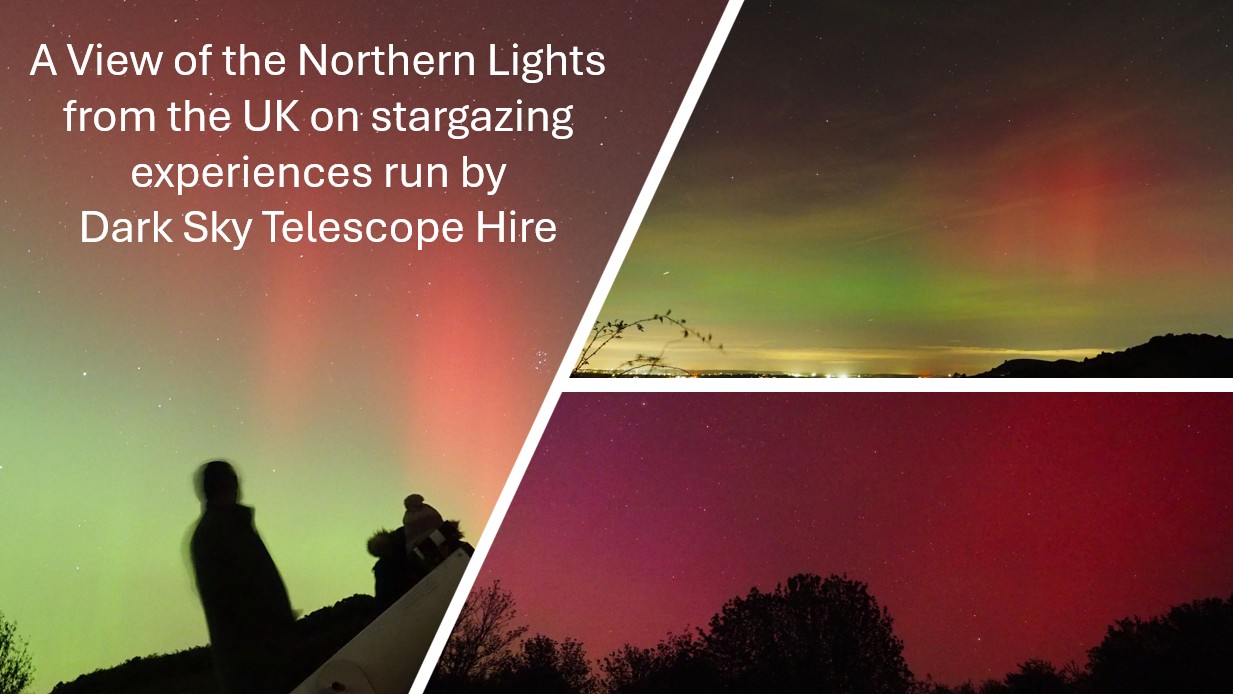
The Solar Wind Funnel and CMEs
Our Sun is the main driving force behind the aurorae
borealis. Earth is constantly buffeted by a stream of charged particles flowing
out from the Sun. Electrons and protons in this solar wind are mostly
deflected around Earth thanks to our planet’s magnetosphere.
Some of the charged particles from this outflow however do get
trapped by Earth’s magnetic field lines and funnel down towards the polar
regions – Earth after all is essentially just one big giant bar magnet!
As the particles funnel lower towards the poles they collide
with nitrogen and oxygen molecules in our upper atmosphere, throwing them into
an excited energy state. Dissipation of excess energy from this interaction
causes the molecules to glow and creates the colours that we see as the
Northern Lights.
Our Sun is a thermonuclear reactor. It fuses more than 700
million tonnes of hydrogen into helium every second! It also rotates on its
axis. Being essentially a huge sphere of hot plasma not all parts of the Sun
rotate at the same speed. In fact it takes about 10 days longer
for the Sun’s polar regions to rotate around its axis compared to its
equatorial regions.
This rotational disparity means that the Sun’s magnetic field
lines associated with all that hot plasma get twisted and distorted over time.
Eventually these loops of magnetism snap under the strain ejecting plasma and
charged particles out into the solar system. Should one of these coronal
mass ejections or CMEs be directed towards Earth then there’s a high
chance we’ll experience a geomagnetic storm.
Geomagnetic Storms and the Solar Cycle
CMEs accelerate the solar wind, loading it up with a higher
density of electrons and protons. When they smash into Earth our magnetosphere
distorts and compresses allowing more charged particles to accelerate down towards
the polar regions and push out to lower latitudes, bringing the Northern Lights
southwards.
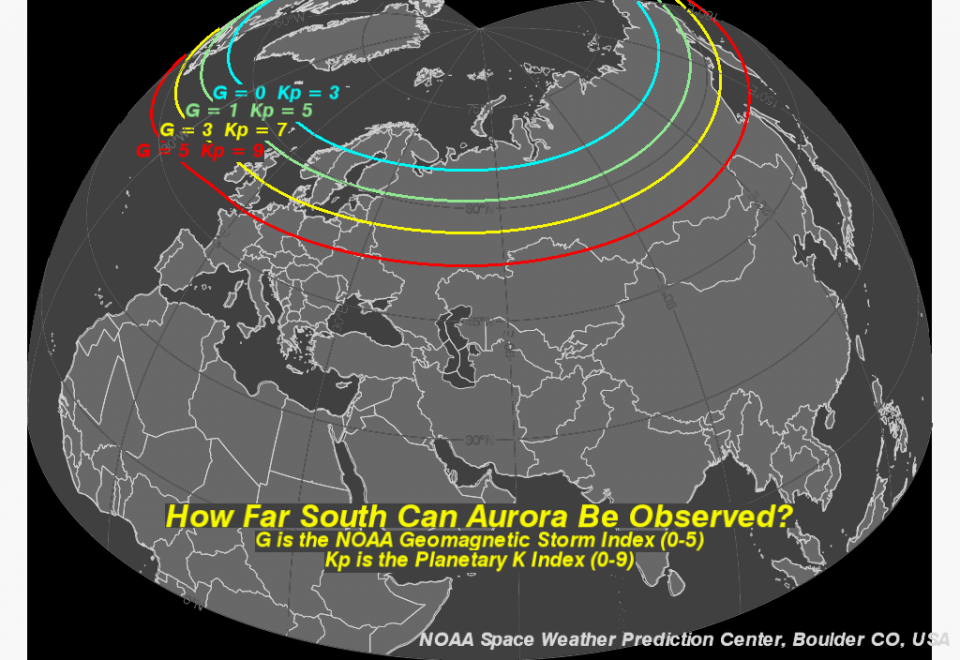
The strength of these solar storms is measured using
magnetometer data collected from observatories worldwide. A planetary index
scale (Kp Scale or Kp Index) is used to determine the severity of a storm.
Minor storms register as a 4 or 5 on the Kp index and won’t be visible from the
UK. Major geomagnetic storms however, which register between Kp 7 and Kp 9 on
the Planetary Index, will most likely result in an auroral display visible from
northern parts of the UK and sometimes from the south of the British Isles.
How often the UK experiences a major solar storm is linked to
the amount and potency of CMEs being thrown off the Sun. This in turn is
governed by the solar cycle.
Like Earth the Sun is a giant bar magnet - but much, much
bigger! After all you could fit more than 1,300,000 Earths inside the volume of
our Sun.
Now remember that the Sun rotates faster at its equator than
in the polar regions creating those distorted magnetic loops that can snap and
send CMEs out into space. It is a process that builds over time. Year upon year
those magnetic field lines get ever more tangled and confused through
rotational disparity, snapping more often pushing out higher numbers of CMEs.
Eventually the Sun’s magnetic field lines get so twisted it
causes a solar magnetic reversal. Magnetic north flips to magnetic south, and
magnetic south switches to magnetic north. This upheaval adds further to CME
activity, increasing the chances of Earth being hit by a big solar storm. It
can take 2 – 3 years for the Sun to settle back down again and for CME activity
to subside.
From observations we know the Sun flips its poles every 11
years or thereabouts. The point at which it does is known as solar maximum. The
dip down in activity between when the Sun reaches its most settled and least
twisted state is known as solar minimum.
2024 and into 2025 saw solar maximum. During the summer of
2025 the Sun’s poles flipped and so we remain in an unsettled phase in 2026
where solar activity is still high, and therefore we still have a good
chance this year to see the Northern Lights from the UK. Expect maybe 2 or 3 major
northern lights displays through 2026, with maybe a smattering of lesser storms.
In 2027 and 2028 we’ll likely see the Sun settle down with
gradually fewer CMEs and therefore a reducing chance of catching the lights
from lower latitudes. That said 1 or 2 major storms per year are still possible
right through until the end of 2028, so keep your eyes to the skies!
How to see the Northern Lights from the UK
When a solar storm is on the go find an observing spot with a
good view to your northern horizon. When I say ‘good’ I’m talking an open view
with few obstructions such as tall trees or buildings, and a northern horizon
that is relatively dark, so not overlooking town or city lights if possible.
You’ll need some clear sky – the northern lights can’t be
seen if the sky is cloudy. Give yourself a good 5 to 10 minutes for your eyes
to adapt to the dark. As long as you can see some stars with the naked eye you’ll
be good to go.
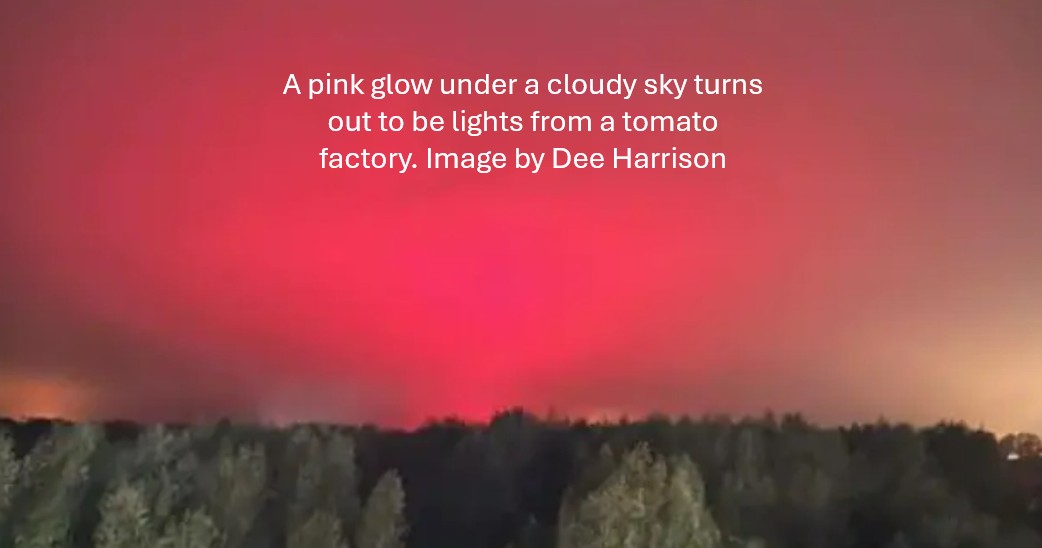
Many northern lights displays start with a grey-green glow. If
you’re familiar with your observing location on a standard clear night you’ll
be familiar with the natural level of darkness that hangs over its northern
horizon. If the light level seems elevated in this direction, so less dark than
usual, you might have the beginnings of a display.
Moonlight will affect the view. If you have a full moon or
near full moon you’ll still be able to see a northern lights display. It might
just not be as obvious as when viewed on a moonless night, or on a night before
the moon has risen or after it sets.
A really good way to check if you have an ongoing northern
lights display is to use your phone camera or DSLR live view. Camera sensors
are much more adept at picking up colour and light in dimly lit situations. Sometimes
the aurorae borealis can be so dim to the naked eye that only a phone camera or
DSLR will pick it up!
Set your phone camera to night mode and hold it steady to
take a photo of your northern horizon. If you have a green and / or red glow
with vertical stratification / beams going on then you’ve got yourself an image
of the northern lights!
Dark Sky Telescope Hire – Copyright 2016-2026. All Rights Reserved.
Page generated in 0.0003 seconds.